
Product 29861 in the old Blue Groove catalogue was a replacement body for a particular Revo configuration. Two surviving category pages identify it as the Revo 3.3 Stealth LP Lexan Body for Side Pipe Conversion, with the part code REVO158. That gives an old forum link a specific destination again: a body reference, rather than a generic truck accessory.
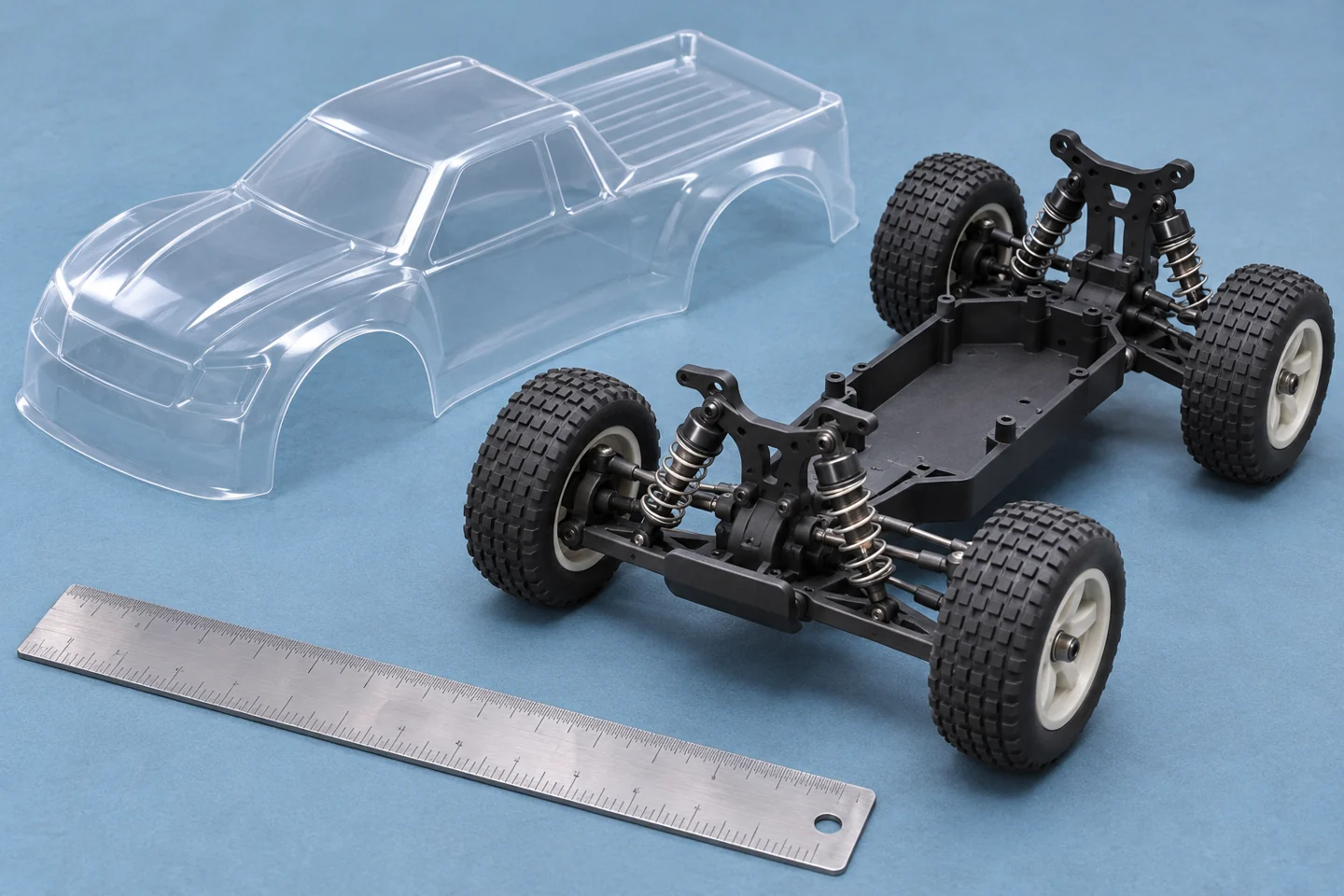
This is a historical identification and a workshop checklist. The former shop is not operating here, and this journal does not sell the body or hold its installation instructions. The cover illustration shows generic workshop objects; it is not a photograph or reconstruction of REVO158.
What the catalogue establishes
The category capture dated 1 February 2008 places REVO158 under body shells. Its listing describes a low-profile stadium-truck body intended for the Revo 3.3 extended chassis with a side-pipe conversion. It gives the material as .050-inch Lexan. A second category capture, dated 7 May 2008, repeats the same product number, name and code.
Those details identify the intended application recorded by the seller. They do not establish fit with every exhaust layout, body mount or later chassis revision. Nor does the surviving short description establish a complete set of dimensions, a trimming template or a tested clearance around a particular pipe.
Check the February 2008 body-shell listing and the May 2008 Revo category. These are historical source pages, not current order forms.
Identify the chassis before judging the shell
Start with the actual chassis and its manufacturer documentation. Record the model and revision, the installed body mounts and the exhaust arrangement. A seller’s photograph of a familiar-looking truck is not enough to resolve a changed mounting system.
If an old body is offered without its packaging, ask for views of the underside, mounting holes and cut edges. Keep any original part label with those photographs. Compare the evidence with the recorded application instead of treating the word “Revo” as a universal fit guarantee.
Make clearance a separate check
A shell can sit on its mounts and still need further investigation. With the vehicle switched off, stationary and fully cool, inspect the relationship between the body, exhaust, wheels and moving suspension. Follow the vehicle manufacturer’s instructions for any movement or adjustment. Do not start the engine as a shortcut for deciding whether an unknown body installation is suitable.
Write down where a clearance is uncertain. Ask the relevant manufacturer or a competent model technician for a supported arrangement before cutting, heating or modifying a part. This historical catalogue entry supplies no exhaust-temperature limit, safe gap or approved heat shield, so this page supplies none either.
Separate appearance, fit and performance
The old listing’s low-profile description tells us how the body was marketed. It does not provide an aerodynamic comparison or measured handling result. Treat the visual choice and the fit assessment as separate decisions; keep performance claims out of the conclusion unless a relevant test supports them.
For a useful workshop record, keep the chassis identity, body identification, photographs, unresolved interfaces and any manufacturer instructions together. Continue with the RC run notebook after the installation is supported and checked. The historical catalogue guide connects the other recovered Blue Groove subjects.