
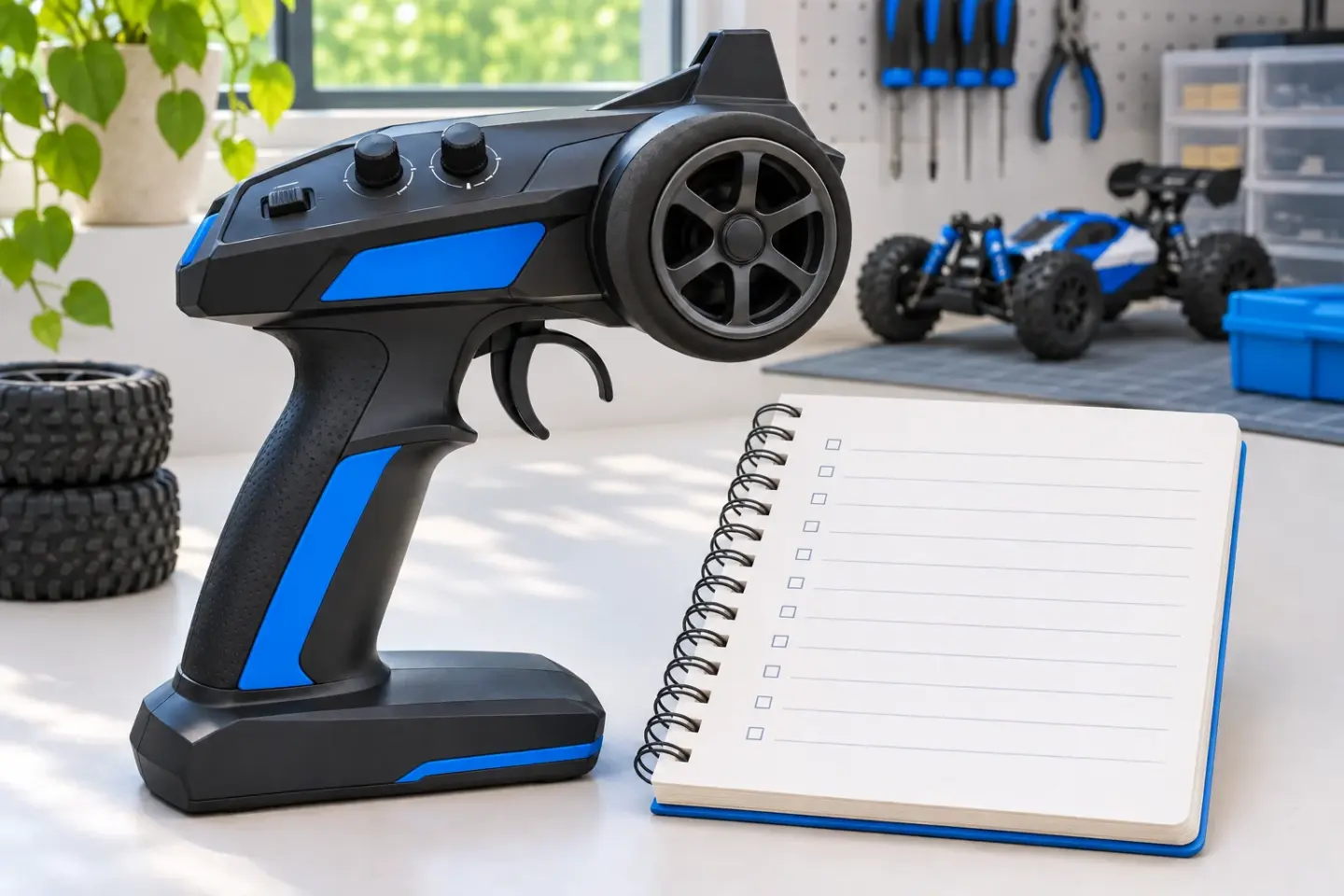
A car that feels nervous can send you straight into the radio menus. Before changing a curve, separate the complaint into three layers: your contact with the transmitter, the vehicle’s available steering travel, and the relationship between wheel movement and steering response. Each layer has a different check. Mixing them makes a small problem harder to diagnose.
This guide continues the old Blue Groove category for controller steering wheels and grips. It applies as a diagnostic order, not a universal button sequence. Menu names, adjustment directions and supported features depend on the radio.
Layer one: can your hands operate the radio consistently?
With power off, hold the transmitter as you would at the track. Check whether you can move the wheel through its normal range without shifting your grip. Check whether your trigger finger rests comfortably at neutral and can operate both directions without pulling the radio sideways. Use the same posture each time you compare parts.
Describe a physical problem physically. “The rim slips beneath my fingertips” is a better note than “steering is vague.” “I move my hand to reach full lock” points toward reach or wheel geometry. If you are investigating a replacement ring, use the Pro Grip fit checklist and preserve the original wheel arrangement.
Do not let a new accessory obstruct a switch or trim control. Check wheel return after installation. Binding, a rough spot or incomplete return must be resolved mechanically before using software to alter the feel.
Layer two: can the chassis use the commanded travel?
End-point adjustment sets the allowed output travel at each end. Futaba’s 7PX manual treats left and right steering separately and warns that linkage must not bind throughout its stroke. It also notes that other settings can affect the resulting operating range. The practical consequence is simple: recheck movement after changing related settings. Futaba 7PX manual, End Point section.
Prepare the vehicle according to its manual so a powered steering check cannot send it across the bench. Establish the specified mechanical centre and inspect the linkage. Work through the manufacturer’s sequence for centre, direction and limits. Keep fingers away from moving parts. Do not increase travel to make a car “turn harder” when the mechanism has already reached its usable limit.
Record the left and right values as numbers. If they differ, keep the reason with them. A deliberately corrected linkage asymmetry is different from a setting copied from an unknown model memory. Reconfirm that the selected memory belongs to the car in front of you before any run.
Layer three: how does input become steering?
Once fit and travel are sound, compare the car’s response at small, medium and large wheel movements. Features labelled steering curve or exponential alter that relationship. Steering-rate controls and response-speed functions can serve other purposes. Consult the exact manual: identical-looking percentages do not guarantee identical behaviour across radio brands.
Use the radio’s documented default as your recorded reference. Make a modest supported change, then repeat a simple driving task. If your radio displays a curve or output monitor, inspect it before driving so you know what the setting does near neutral and near full travel. Do not rely on remembering whether a plus sign felt softer on a different transmitter.
A three-pass diagnostic
- Straight pass. At a controlled speed, observe whether the vehicle holds direction with the wheel centred. A consistent pull deserves a mechanical and setup check before response tuning.
- Broad turns. Compare comfortable left and right arcs. Note whether the issue is reaching the turn, holding it or unwinding the wheel.
- Gentle direction changes. Look for repeated over-correction, missed re-grips or an abrupt transition around centre. Keep the speed low enough that a mistake remains manageable.
Keep surface, tyre condition and the task as constant as practical. If only one corner on a rough course causes trouble, a general radio adjustment may alter every other corner unnecessarily. Write the location and phase of the problem instead of turning the entire radio setup into a remedy.
The finish line is a known baseline
Save a copy of the working model memory if your transmitter supports it. Keep a photograph of the wheel arrangement and a short list of changed settings. A person returning to the car next month should be able to distinguish comfort adjustments from mechanical limits and response preferences. That record is more useful than a set of impressive-looking percentages with no explanation.